Xactimate is the undisputed software standard used by over 80% of insurance carriers, independent adjusters, and restoration contractors across North America. It calculates localized line-item unit pricing for thousands of specific construction and remediation tasks based on monthly regional cost surveys.
However, the accuracy of an Xactimate estimate depends entirely on the data entered by the adjuster. Independent field adjusters working for insurance carriers frequently operate under strict corporate scoping guidelines that omit necessary preparatory, safety, and code-compliance line items.
When our estimating team reviews initial carrier estimates, we routinely identify 10 major omitted items: 1) Floor and dust containment barriers; 2) HEPA air scrubber filter replacement costs; 3) Debris haul-off and transfer station tonnage fees; 4) Baseboard detachment vs replacement allowances; 5) Multi-story ladder and scaffolding setup charges; 6) Drywall texture matching allowances; 7) Pre-condition moisture mapping and daily thermal camera fees; 8) General Contractor Overhead & Profit (10 & 10); 9) Electrical AFCI code upgrade supplements; and 10) Paint prep, masking, and primer seal coats.
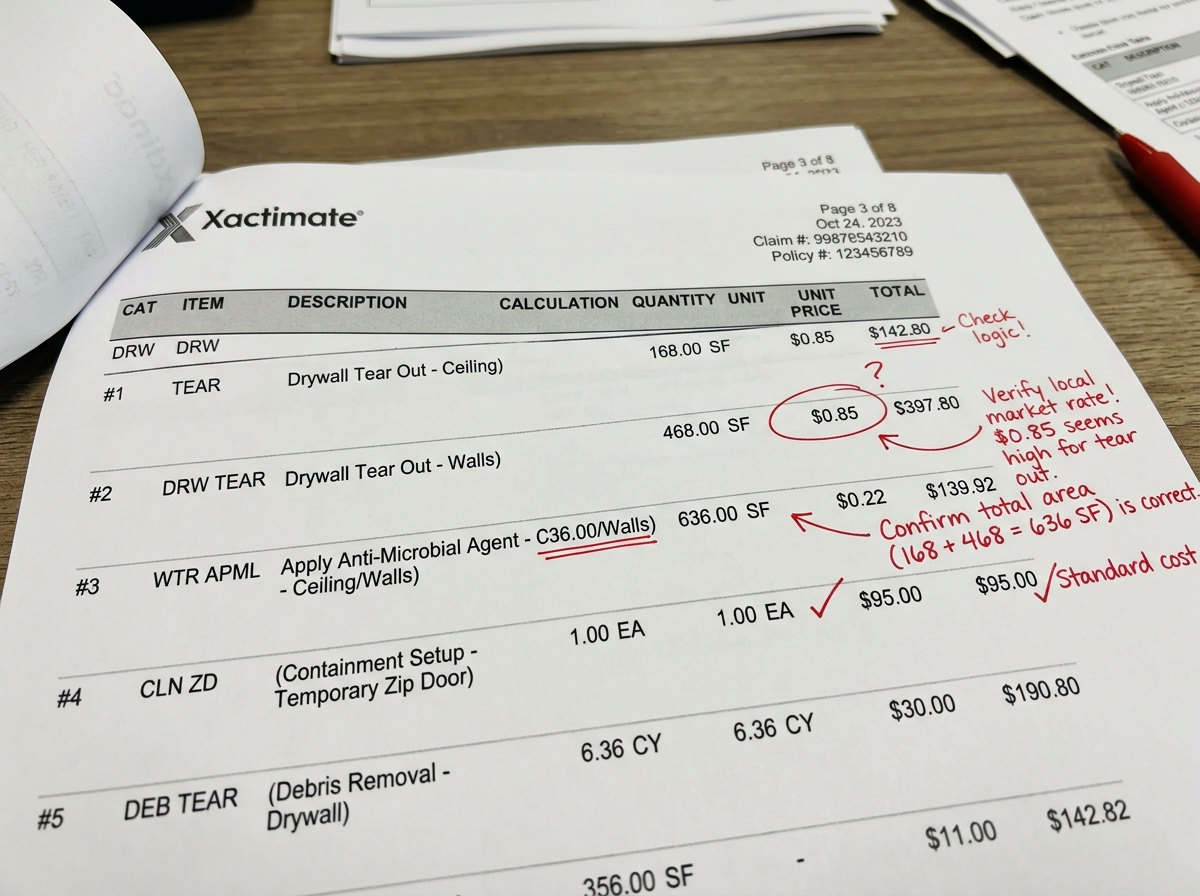
When these items are omitted, the homeowner faces an artificial budget deficit. By submitting a formal line-item contractor supplement backed by date-stamped photographic evidence, thermal moisture logs, and building code citations, we negotiate the scope directly with the carrier’s desk adjuster before reconstruction starts.
Another critical area frequently miscalculated is the application of General Contractor Overhead & Profit (O&P). Under established insurance case law and the ‘Three Trades Rule,’ whenever a loss requires a general contractor to coordinate three or more distinct trades (e.g. framing, electrical, drywall, and painting), a standard 10% overhead and 10% profit addition is mandatory.
Cross-referencing room dimensions and wall square footages against actual laser field measurements often exposes deductions where adjusters subtracted full window and door openings from drywall sheets, failing to account for standard construction material waste factors.
From an insurance claims and policyholder advocacy perspective, recovering the full replacement cost value (RCV) of damaged property requires detailed knowledge of insurance estimation software mechanics. Cross-referencing insurance adjuster estimates against actual construction contractor scopes frequently reveals significant line-item omissions in dust containment, code upgrades, scaffolding, and General Contractor Overhead & Profit (10 & 10).
By preparing an itemized contractor supplement backed by date-stamped moisture logs, building code citations, and manufacturer installation guidelines, policyholders can successfully bridge valuation gaps with insurance carriers. If a carrier refuses to negotiate in good faith, policyholders retain the legal right to invoke the statutory Appraisal Clause, allowing an independent umpire and appraisers to establish a fair, binding claim settlement.
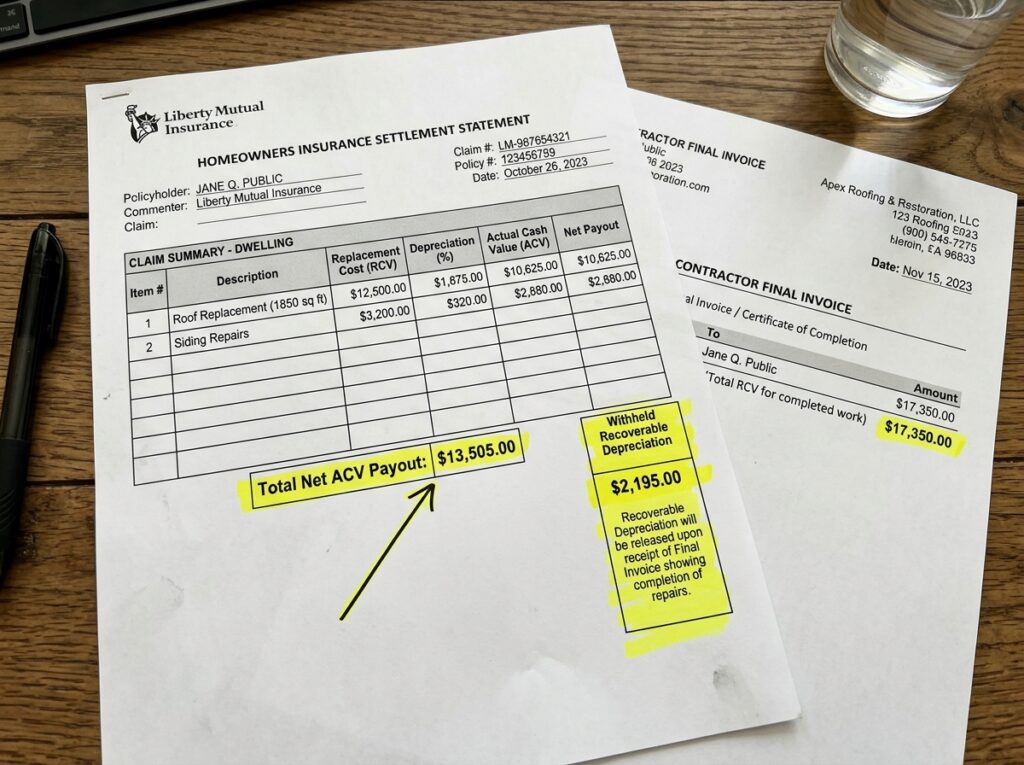
Navigating the property insurance claim life cycle requires policyholders to adhere strictly to statutory policy deadlines. Most standard homeowner insurance policies mandate that a formal, notarized Sworn Proof of Loss statement be submitted within 60 days of the carrier’s initial written request. Furthermore, recoverable depreciation funds held in escrow must be formally claimed within 180 to 365 days from the date of loss. Maintaining organized digital copies of all contractor progress invoices, paid deductible receipts, and signed lien waivers guarantees that withheld depreciation funds are released promptly without administrative delays.
To learn how to submit final repair documentation, see our guide on claiming withheld recoverable depreciation. If negotiations reach an impasse, review our breakdown on the insurance statutory appraisal clause. Discover all claims strategies in our Insurance Claims Knowledge Hub.