Microbial remediation in residential environments is not simply a matter of spraying chemicals on drywall. When mold colonies are disturbed during demolition, millions of microscopic spores, hyphal fragments, and mycotoxins aerosolize into the indoor air. Without strict engineering controls, tearing out a small patch of moldy baseboard can contaminate the entire home’s HVAC ductwork and living spaces.
Under the ANSI/IICRC S520 Standard for Professional Mold Remediation and EPA guidelines, any remediation project involving more than 10 square feet of fungal colonization requires critical containment. We construct airtight physical barriers using heavy-duty 6-mil flame-retardant polyethylene sheeting, sealed with non-damaging painter’s tape and spring-loaded tension poles, complete with a two-stage zippered decontamination chamber.
Inside the containment zone, continuous negative air pressure is established using commercial HEPA air scrubbers ducted to exhaust outside the building. The air filtration device must achieve a minimum pressure differential of -0.02 inches of water column (monitored continuously via digital recording manometers) and provide at least 4 to 8 complete air changes per hour (ACH).
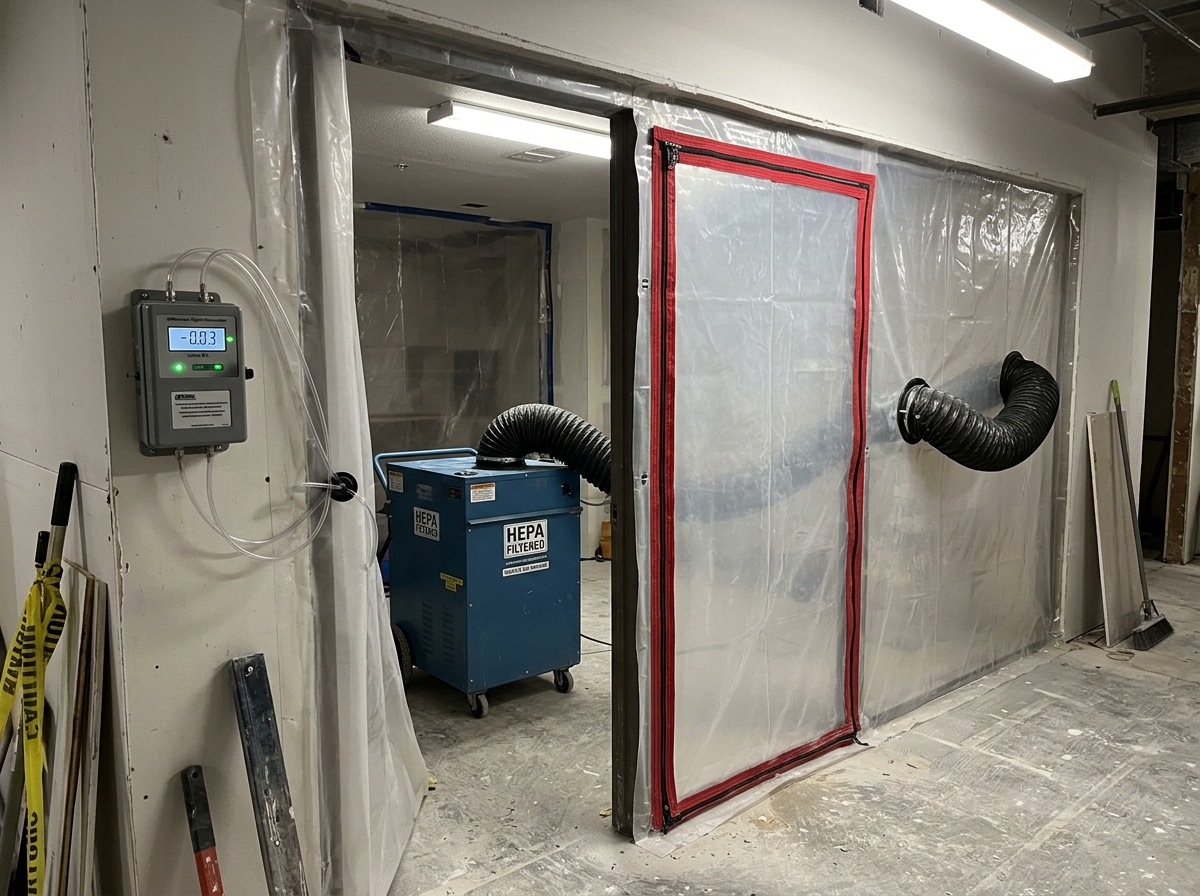
Once all colonized drywall is bagged in 6-mil poly before exiting the decon chamber, all structural timber framing is HEPA vacuumed, hand-scrubbed with botanical biocides, and treated with an antimicrobial sealant. Containment barriers remain sealed until an independent third-party Indoor Environmental Professional (IEP) conducts Post-Remediation Verification (PRV) spore trap air sampling, confirming indoor spore levels are lower than outdoor reference baselines.
The physical decontamination sequence inside containment follows strict top-to-bottom, clean-to-dirty progression. Technicians wipe down all ceiling joists, wall studs, and subflooring using micro-fiber rags dampened with quaternary ammonium or botanical thymol solutions, ensuring zero residual fungal dust remains settled on horizontal surfaces.
After cleaning, an aerosolized fungistatic encapsulant coating is applied to semi-porous framing studs. This breathable, mold-resistant elastomeric barrier contains active EPA-registered antimicrobial additives that permanently prevent future fungal spores from colonizing the wood even if temporary humidity spikes occur.
From an indoor environmental engineering perspective, establishing airtight physical containment also requires continuous differential pressure monitoring. Digital recording manometers measure pressure differentials down to thousandths of an inch of water column, sounding automatic audible alarms if duct seals breach or pressure drops below -0.02 in. WC. This failsafe mechanism ensures that fungal spores, micro-particulates, and mycotoxin dust are 100% trapped within the HEPA filtration envelope.
Following remediation and antimicrobial sealing, formal Post-Remediation Verification (PRV) testing is coordinated with an independent third-party Indoor Environmental Professional (IEP). The IEP performs visual white-glove dust inspections and collects comparative spore trap air samples (Air-O-Cell cassettes). Remediation containment barriers are removed only after the certified laboratory issues a formal pass letter confirming indoor spore counts are within healthy background ranges.
Biological mold remediation must also account for cross-contamination pathways through the home’s heating, ventilation, and air conditioning (HVAC) systems. Prior to starting negative air containment machines, the HVAC return and supply vents inside the work zone are sealed with 6-mil polyethylene and heavy-duty tape. Air handling units are shut down to prevent the furnace blower from circulating disturbed fungal spores into occupied bedrooms and common living areas, ensuring that the containment envelope remains completely isolated from the rest of the dwelling.
To understand fungal biology and health hazards, read our breakdown on Stachybotrys black mold vs Cladosporium. If mold has originated in the attic rafters due to ventilation failure, see our contractor specs on attic mold remediation and roof baffle ventilation. Discover all testing protocols in our Mold Remediation Knowledge Hub.