Homeowners who discover visible discoloration behind wallpaper, under bathroom sinks, or along basement baseboards are frequently alarmed by the phrase ‘toxic black mold.’ While media sensationalism has created confusion, understanding the biological reality of mold species is essential for making informed, science-based remediation decisions.
Stachybotrys chartarum is a slow-growing, moisture-loving fungal species characterized by a dark greenish-black, slimy appearance when active. Unlike common outdoor molds, Stachybotrys requires sustained, heavy water saturation on high-cellulose, low-nitrogen building materials (such as drywall paper, wood fiberboard, and ceiling tiles) over several weeks to colonize. It is known to produce macrocyclic trichothecene mycotoxins.
In contrast, Cladosporium and Penicillium/Aspergillus are ubiquitous airborne fungal genera that can colonize surfaces under much lower relative humidity thresholds (60% to 70% RH). While they appear dark brown, green, or grey, they release lighter, dry airborne spores that trigger severe allergic rhinitis, asthma exacerbations, and upper respiratory irritation in sensitized individuals.
From an IICRC S520 remediation standpoint, identifying the exact fungal species does not alter the physical remediation protocol. Whether dealing with Stachybotrys, Aspergillus, or Chaetomium, any indoor fungal amplification represents abnormal indoor ecology that requires source moisture elimination, negative air containment, HEPA filtration, and structural removal.
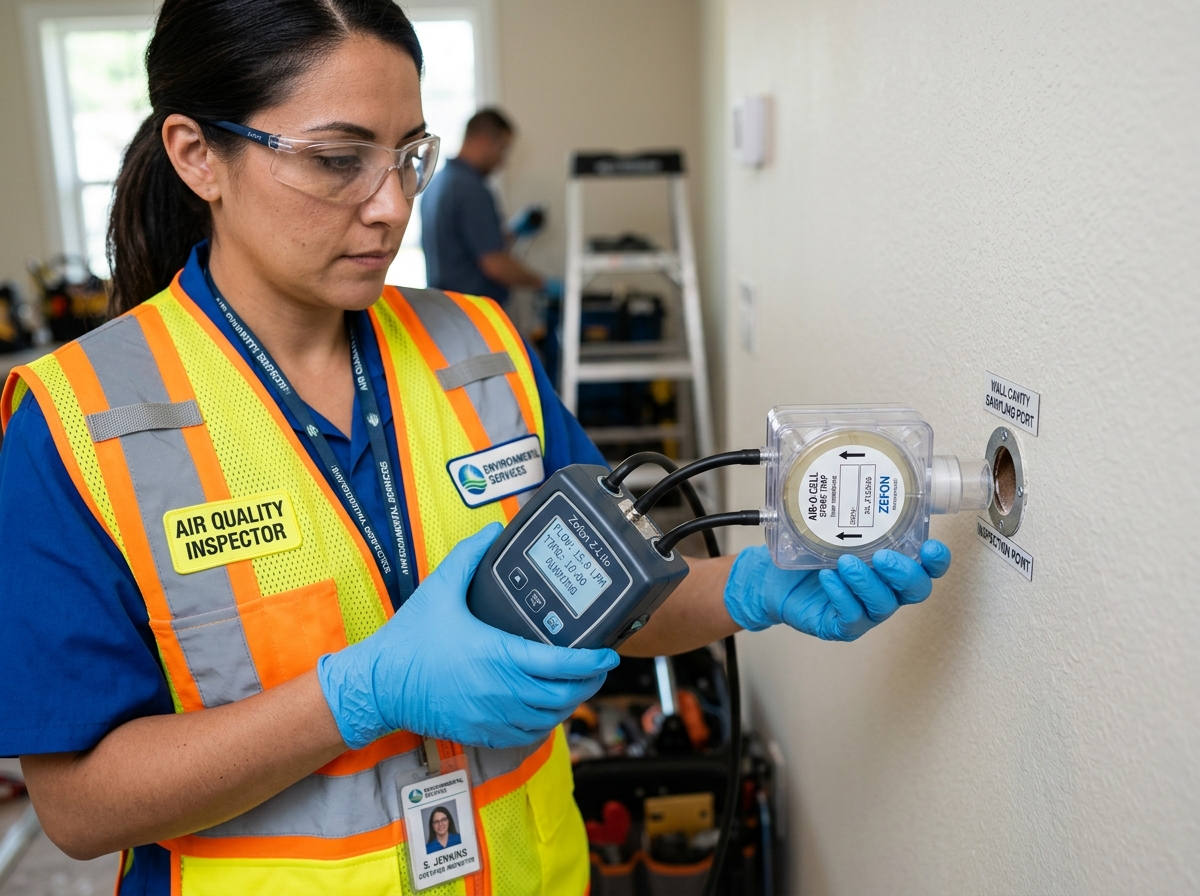
Proper environmental testing involves collecting non-viable spore trap air cassettes (such as Air-O-Cell or Allergenco-D) alongside outdoor reference controls. An accredited microbiology laboratory analyzes the samples under optical microscopy to quantify spore counts per cubic meter (spores/m3) and determine if indoor concentrations reflect fungal amplification.
Crucially, home test kits sold at retail hardware stores are fundamentally flawed: they lack calibrated airflow meters, cannot measure air volume, and will invariably grow mold spores that naturally exist in every home, providing zero actionable diagnostic value.
From an indoor environmental engineering perspective, establishing airtight physical containment also requires continuous differential pressure monitoring. Digital recording manometers measure pressure differentials down to thousandths of an inch of water column, sounding automatic audible alarms if duct seals breach or pressure drops below -0.02 in. WC. This failsafe mechanism ensures that fungal spores, micro-particulates, and mycotoxin dust are 100% trapped within the HEPA filtration envelope.
Following remediation and antimicrobial sealing, formal Post-Remediation Verification (PRV) testing is coordinated with an independent third-party Indoor Environmental Professional (IEP). The IEP performs visual white-glove dust inspections and collects comparative spore trap air samples (Air-O-Cell cassettes). Remediation containment barriers are removed only after the certified laboratory issues a formal pass letter confirming indoor spore counts are within healthy background ranges.
Biological mold remediation must also account for cross-contamination pathways through the home’s heating, ventilation, and air conditioning (HVAC) systems. Prior to starting negative air containment machines, the HVAC return and supply vents inside the work zone are sealed with 6-mil polyethylene and heavy-duty tape. Air handling units are shut down to prevent the furnace blower from circulating disturbed fungal spores into occupied bedrooms and common living areas, ensuring that the containment envelope remains completely isolated from the rest of the dwelling.
To learn how certified contractors establish containment, read our guide on EPA & IICRC S520 negative air containment standards. If you are experiencing plumbing leaks behind fixtures, consult our article on the first 24 hours of moisture mitigation. Check our transparent standards in the Benson Editorial Guidelines.