Solid hardwood flooring is one of the most valuable architectural features of a residential home, but it is also exceptionally hygroscopic. When water migrates beneath solid oak, maple, or engineered planks, the bottom unfinished face of the wood absorbs moisture and expands much faster than the polyurethane-sealed top surface. This unequal expansion forces the outer edges of the planks upward while the center remains low—a classic structural distortion known as cupping.
A frequent and expensive mistake made by property owners is attempting to drum-sand cupped floorboards immediately after a water loss. Sanding a cupped floor while the subfloor remains wet removes the raised edges permanently. Once the underlying plywood subfloor eventually dries out over subsequent months, the planks shrink back down, leaving the centers raised and edges sunken—a ruined condition known as crowning that requires complete hardwood demolition.
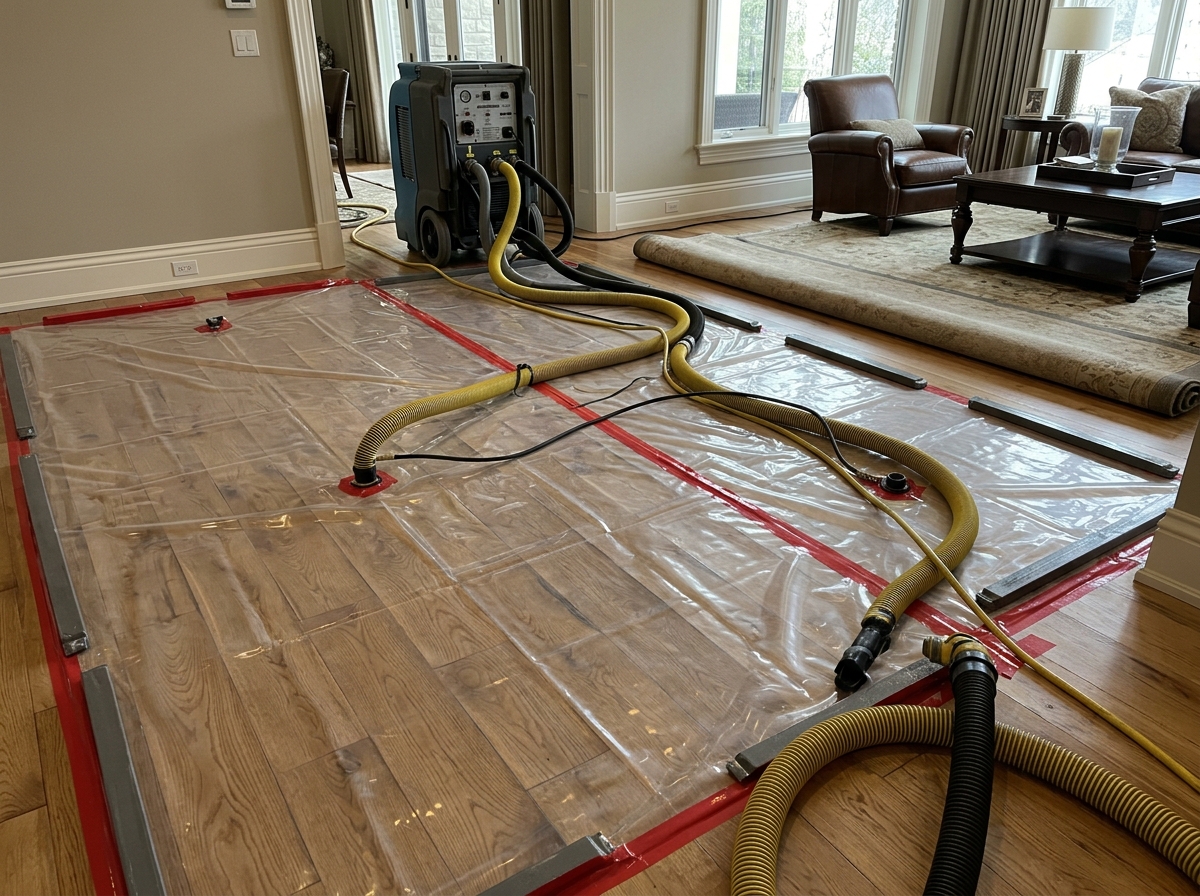
Modern IICRC-compliant restoration utilizes specialized floor vacuum mat injection systems. These clear, semi-rigid gasketed panels are taped directly over the cupped planks in an airtight grid. High-pressure negative vacuum extractors pull continuous air down through the tongue-and-groove joints, drawing trapped moisture out from between the subfloor and hardwood without pulling a single nail or marring the finish.
Technicians use hammer-probe resistance pin meters with insulated Teflon-coated pins to take daily core moisture readings at various depths. This allows restorers to monitor the moisture gradient between the surface wear-layer and the deep subfloor interface. Drying is continued until the hardwood reaches its baseline Wood Moisture Equivalent (WME), typically between 8% and 11% depending on the regional ambient climate.
In addition to vacuum panels, auxiliary Low-Grain Refrigerant (LGR) dehumidifiers must be placed in the room to process the heavy volume of evaporated water vapor discharged by the vacuum blower. By maintaining room relative humidity below 30%, the ambient air greedily absorbs moisture pulled from the floorboard cellular capillaries.
During this active vacuum extraction cycle, technicians continuously evaluate the floor for sign of adhesive delamination or subfloor fastener failure. By applying gentle, uniform negative pressure rather than excessive heat, the cellular integrity of the hardwood is maintained without splitting the grain or cracking the tongue-and-groove joints.
From an engineering standpoint, managing structural drying requires calculating specific moisture evaporation rates against the cubic footage of the affected structure. Technicians calculate the required pint removal capacity per day (AHAM rating) using the formula specified in the ANSI/IICRC S500 standard. By accounting for Class 1 through Class 4 water absorption factors, the precise ratio of LGR dehumidifiers and high-velocity air movers is configured to maintain a continuous grain depression exceeding 25 to 30 GPP throughout the structural drying cycle.
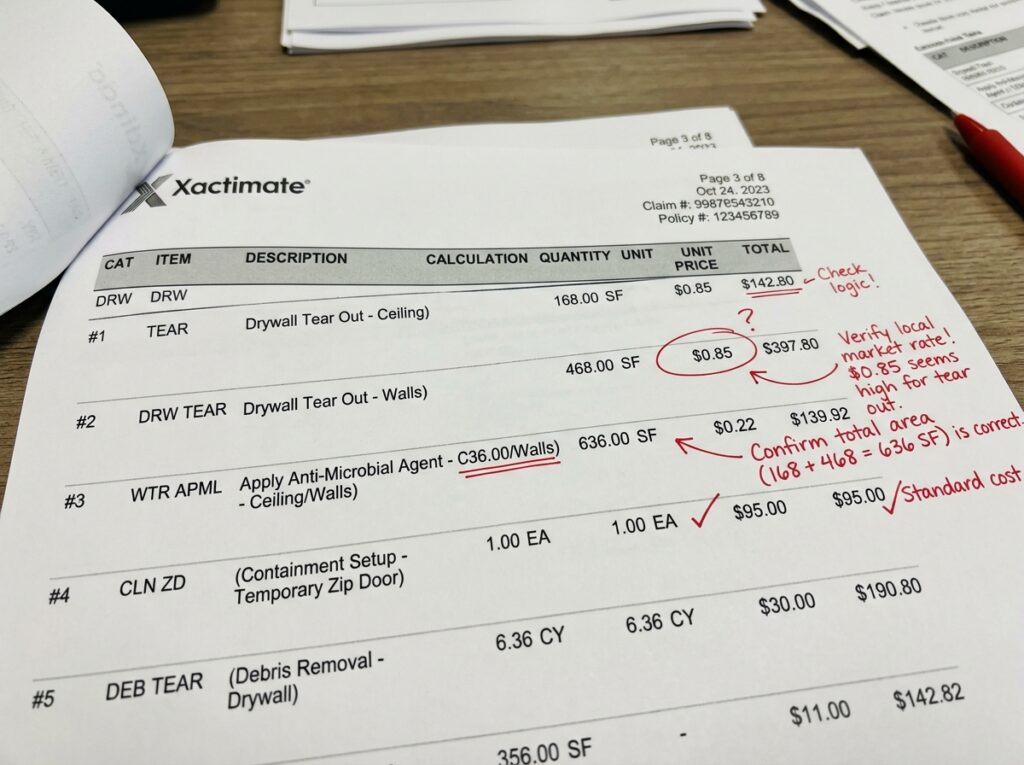
In addition to on-site moisture extraction, comprehensive field records must be compiled for insurance claim submittal. Every restoration phase—including daily psychrometric psychrometer logs, thermal imaging false-color screenshots, moisture map floor plans, and antimicrobial application certificates—is itemized using industry-standard Xactimate pricing codes (such as WTRDRY and WTRDH). This eliminates scope ambiguity with insurance desk adjusters and expedites claim reimbursement for emergency mitigation costs.
In addition to psychrometric calculations, certified technicians maintain a stringent drying checklist throughout the 72-hour emergency stabilization window. Moisture mapping begins at the initial source of intrusion and extends outward in all four compass directions until zero elevated moisture readings are detected on adjacent drywall assemblies. Infrared thermal imaging scans are repeated every 24 hours at the exact same times of day to establish comparative thermal evaporation curves. These objective data points prove that the structural assembly is returning to its dry standard baseline without requiring premature demolition of salvageable building materials.
Once equilibrium moisture content is achieved, the wood fibers settle back into their original flat orientation. This non-destructive drying method saves thousands of dollars in hardwood replacement costs, avoids weeks of noisy construction, and preserves original historical flooring assemblies. Understanding moisture science is critical for preventing secondary rot; review our analysis on the first 24 hours of psychrometric drying for complete mitigation guidelines. If subfloor joists beneath the planks have experienced structural sagging, see our contractor breakdown on subfloor delamination and joist deflection repairs. For personalized assessment, review our definitions in the Property Restoration Glossary or consult our licensed restoration team.